Are your shoulders constantly tense while typing? Learn the perfect ergonomic formula to set your desk height and completely eliminate upper body strain.
Ergonomic Desk Height Calculator
Input your height below to calculate your scientifically optimal chair, sitting desk, and standing desk positions.
When people think about office ergonomics, they usually focus on buying an expensive chair or adjusting their monitor screen. But there is a silent culprit sitting right in front of you that might be causing that stubborn tightness in your upper back and shoulders: your desk height.
Most standard office desks are built to a default height of 29 to 30 inches. While this accommodates taller individuals, it is actually way too high for the average person.
If your desk is too high, you are forced to shrug your shoulders slightly to rest your hands on the keyboard. Doing this for eight hours a day leaves your trapezius muscles completely exhausted.
Here is the simple, step-by-step formula to find your perfect desk height and protect your upper body.
The 90-Degree Elbow Rule
The absolute best way to check your desk height is by looking at your arms while sitting in your adjusted office chair.
- The Test: Sit all the way back in your chair with your shoulders completely relaxed. Bend your elbows at a 90-degree angle.
- The Sweet Spot: Your forearms should be completely parallel to the floor, and your hands should rest gently on your keyboard or mouse without your wrists bending upward or downward.
If your elbows are forced open wider than 90 degrees to reach your keyboard, your desk is too low. If your hands are higher than your elbows forcing your shoulders to squeeze up toward your ears your desk is too high.
How to Measure and Adjust Your Setup
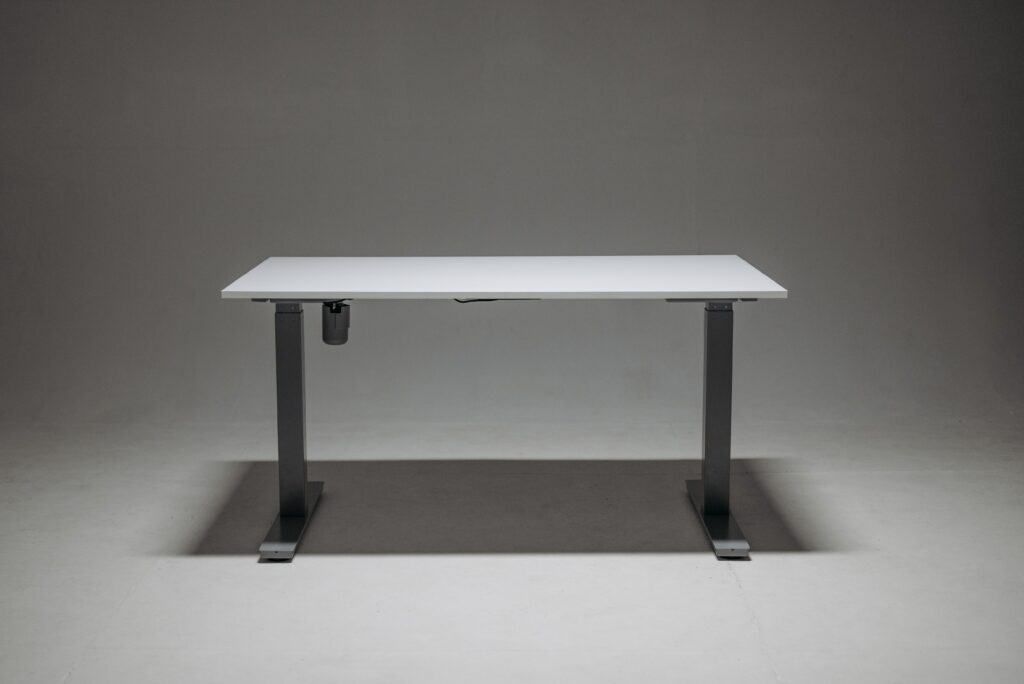
Finding the perfect physical height depends entirely on how tall you are. For a quick baseline, a person who is 5'9" (175 cm) typically needs a desk height of around 26 to 27 inches a couple of inches lower than standard non-adjustable desks.
If you don't own an adjustable standing desk, don't worry. You can easily fix a desk that is too high using these methods:
- Raise Your Chair and Use a Footrest: The easiest fix is to raise your office chair until your elbows align perfectly with the desk surface. Because your feet will likely lift off the floor when you do this, slide an under-desk footrest underneath them to keep your lower back supported.
- Install a Keyboard Tray: Attaching an adjustable keyboard tray underneath your desktop lowers your typing surface by 2 to 3 inches, instantly bringing your arms into a natural 90-degree alignment.
- Switch to a Compact Keyboard: If your desk is slightly high, a thick mechanical keyboard will make it feel even higher. Switching to a low-profile keyboard can buy your wrists some much-needed relief.
Taking a few minutes to lower your typing plane transfers the physical stress away from your neck and shoulders, allowing your upper body to rest naturally while you work.